
Landmarks on the farm
The skigard, the log houses, the slate walls, the open land and the animals that keep it open: four hundred years of Hallingdal farming, still in use at Huso.
Most of what you walk past every day at Huso was here long before the lodge: the wooden fence that gave the farm its edge, the log houses, the walls of stacked slate and the open, grazed land between them, with the animals and the vegetable garden that keep it a working farm. Each is a piece of Hallingdal’s farming history, and each is still doing the job it was made for.
The skigard
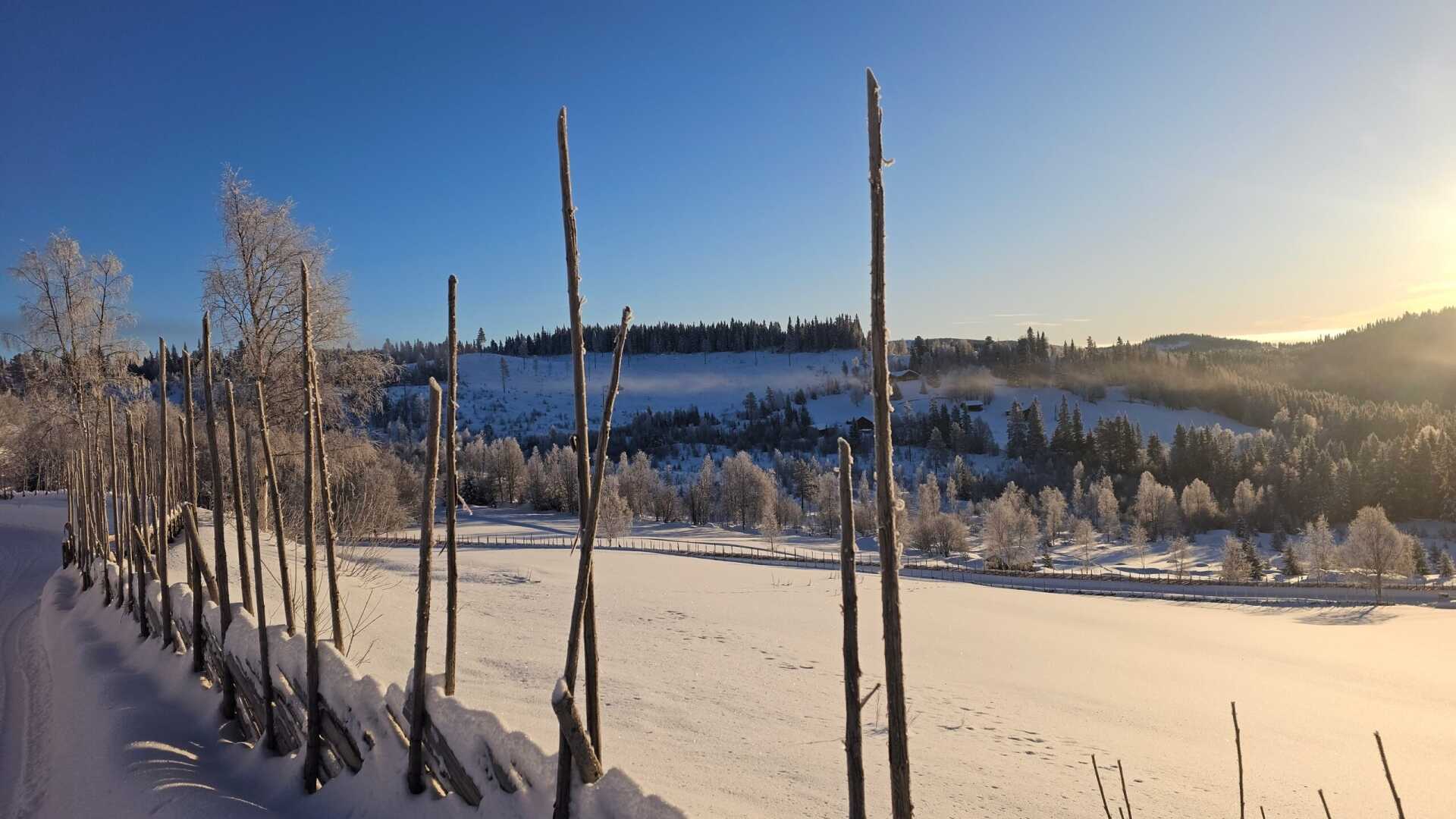
The skigard is the oldest fence in Norway, and the one our mark is drawn from. The name comes from Old Norse skígarðr, and the build has not changed in centuries: pairs of stakes driven into the ground about a metre apart, long split spruce poles laid diagonally between them, and each pole bound to the stakes with withes of spruce or juniper softened over a fire, later with wire. Juniper was the stake of choice, as it does not rot, and the rule of thumb was that the fence should reach a man’s armpits and be tight enough that no axe could be thrown through it.
Its purpose was to divide the farm in two: the innmark, the fields and meadows nearest the houses, and the utmark, the forest and mountain pasture where the animals roamed. A homestead has stood inside the skigard at Huso since the 1600s. The fence was rebuilt generation after generation, as it is still: a skigard is never finished, only kept.
The log houses – hallingstuer
Log building, lafting, reached Norway around the year 900, and the country still has some 250 timber buildings from the Middle Ages, more than anywhere outside Japan. Pine was felled in winter and chosen years ahead for its heartwood; the logs were notched at the corners so that each course locked into the one below, with no nails and no frame. A log house can be taken down log by log, numbered, carted to a new site and raised again, which is why so many old houses in Hallingdal have moved more than once.
The hallingstue is the valley’s own version: a single-storey log house where one big room was kitchen, workshop and bedroom at once, heated first by an open hearth under a smoke hole, later by a chimney, and by the 1800s often grown into a three-room plan with chambers on either side and a tall, narrow pillar cupboard between the doors. Beside it stood the loft or stabbur, a storehouse raised on posts to keep the food dry and the mice out. Between 1985 and 2005 some twenty such houses were brought to Huso from around Hallingdal, one a year, and raised again here.
The slate walls – stablesteinsmurer
Every field in the valley was won from stone. What the plough turned up was carried to the edge and either heaped into clearance cairns or, when there was enough of it, stacked into walls. The technique is tørrmur, dry-stone: no mortar, only weight, friction and a practised eye for which stone wants to lie where. Hallingdal’s slate splits into flat, even slabs, so here the walls are laid course on course like a stack of books, which is what the local name stablestein, stacked stone, describes.
The oldest stone walls in Norway go back to the Iron Age, but most were built in the 1800s, when the land-consolidation law of 1857 gave farmers whole fields to enclose. At Huso the same stone carries the buildings: when Mekkel and Embrik Huso built the new farmhouse and barn between 1928 and 1930, they set them on foundation walls of stacked slate that stand, unmoved, today. A dry-stone wall breathes and drains, and its cracks are home to lichens, insects and the odd lizard.
The cultural landscape – kulturlandskap
The open ground between the houses is not natural. At 800 metres the forest would close over it within a generation; it is open because it has been grazed, mown, trodden and cleared for four hundred years. This is what Norway calls kulturlandskap, the landscape of farming, and its grazed pastures and hay meadows are among the country’s most threatened habitats, home to more than five hundred species at risk. Grazing does not impoverish the ground; it enriches it, letting light in for flowers, fungi, butterflies and the birds that follow them.
In 1850 Norway had at least fifty thousand summer farms sending animals up to pastures like these; today about twelve hundred are still in use, and where the animals have gone the birch, juniper and willow are coming back. Keeping the twenty-two hectares inside the fence at Huso open is part of the work of the farm, because a farm that stops being used stops being a farm.
The animals and the vegetable garden
A landscape like this is kept open by mouths, not machines, and Huso is still a farm with animals on it. Free-range pigs root through the pasture and the forest edge, turning the ground and clearing the scrub the way pigs have on Norwegian farms since the Viking Age; Per Herbrand kept more than a hundred of them here in the 1970s. Sheep graze the meadows and the slopes above the houses through the summer, keeping the birch and juniper down and the flowers up. And there are horses, as there were when Mekkel Huso worked the forest with a horse and sled into his seventies, the last in the valley to do so.
Inside the fence, where the homestead grew its own food for four centuries, the vegetable garden has been re-established as a market garden: beds of roots, greens, herbs and berries grown at 800 metres without chemicals, on a short mountain season that rewards what is hardy and early. What the garden and the animals give goes to the lodge kitchen, to the harvest feast in the autumn and to the farm shop, so that a meal at Huso begins a few steps from the table. You are welcome to walk down and see it, and to say hello to the animals.